

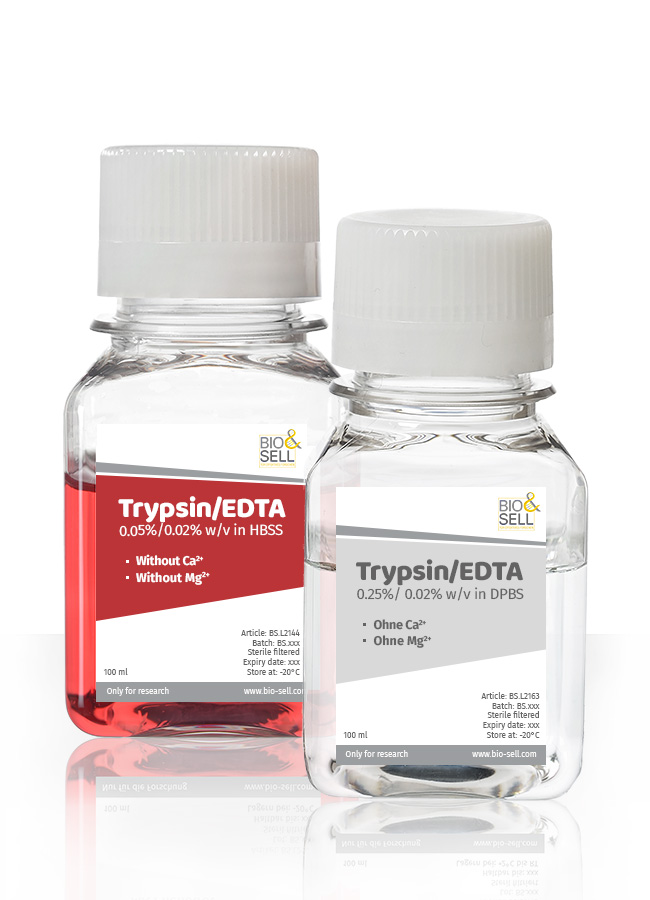
Trypsin/EDTA Solution
Trypsin/EDTA solutions are used to detach adherent cells from cell culture surfaces. EDTA is added to trypsin solutions to scavenge calcium and magnesium ions that inhibit trypsin activity. By removing these ions, the enzymatic activity of trypsin is enhanced and our trypsin is obtained from the pancreas of pigs. Trpysination is a long-established and effective method of cell separation. Depending on the cell type or cell viability, different trypsin concentrations are required. We offer solutions with different trypsin and EDTA concentrations. Find the right solution for your application!
Properties
- Effective detachment of adherent cells
- Without Ca2+, Mg2+
- Available with or without phenol red
- Solubilized in PBS or HBSS
Article list - without phenol red
| Products | Article number | Quantity | Shop |
|---|---|---|---|
|
Trypsin/EDTA (0.25%/0.02% w/v) in DPBS
(without Ca2+, without Mg2+)
|
BS.L2163
|
100 ml
| |
|
Trypsin/EDTA (0.05%/0.02% w/v) in DPBS
(without Ca2+, without Mg2+)
|
BS.L2143
|
100 ml
| |
|
10x Trypsin/EDTA (0.5%/0.2% w/v) in 10x DPBS
(without Ca2+, without Mg2+)
|
BS.L2153
|
100 ml
|
Good to know
Cultured cells must be regularly passaged (split, subcultured) so that they are not exposed to too close cell-cell contacts and reduce their cell division rate by inhibiting cell contact. The passaging rate depends on the cell type (standard culture conditions: 37°C, 5%CO2 at a confluence of approx. 80%). In order to passagate adherent cells or prepare them for analysis, they must first be detached from their culture vessels.
A proven method is trypsinization, a cell separation using trypsin. Trypsin is a serine protease and cleaves peptide bonds on the C-terminal side of basic amino acids such as lysine and arginine. During trypsinization, extracellular adhesion proteins, through which the cells adhere to the surface of culture vessels, are cleaved. The required trypsin concentration depends on the cell type and age of the cultured cells. However, incubation times that are too long can have a negative effect on your cells. More proteins will be cleaved and important cellular proteins can be damaged. It is therefore essential that you stop trypsin activity in good time with a trypsin inhibitor or by adding fetal calf serum (FBS).