

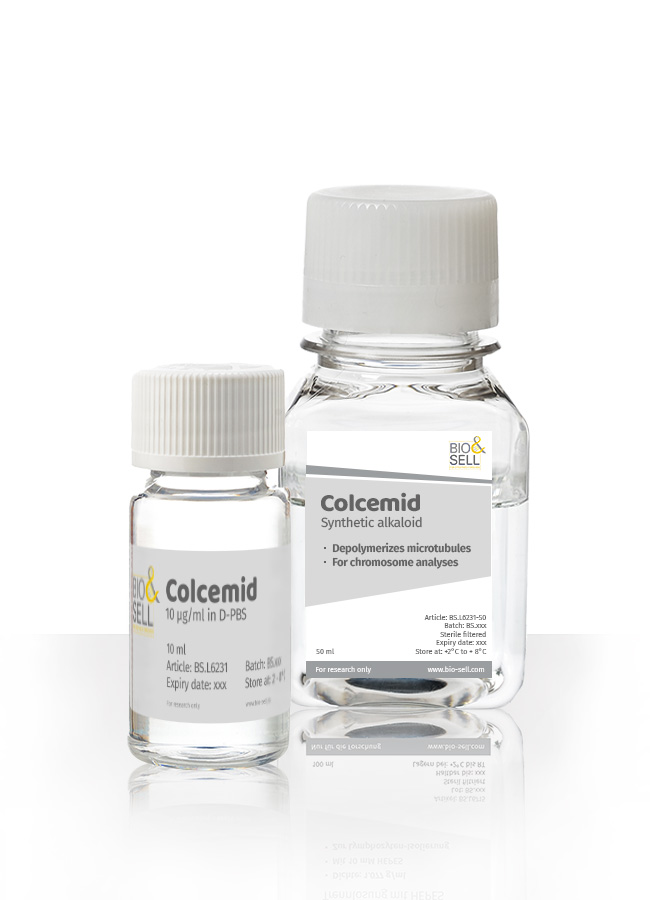
Colcemid (Demecolcin)
Colcemid (Demecolcin) is a synthetic, less harmful analog of colchicine (a toxic alkaloid of Colchicum autumnale). The synthetic alkaloid depolymerizes microtubules and thus inhibits the formation of spindle fibres during cell mitosis. Colcemid is therefore mainly used for chromosome analysis in the karyotyping of lymphocytes and the chromosome analysis of amniotic fluid cells. It arrests the cells during metaphase and exposes chromosomes, which can then be analyzed.
Our Colcemid (Demecolcin) solution is formulated in D-PBS and has a concentration of 10 µg/ml.
Good to know
What is the difference between Colcemid and Demecolcin?
Colcemid and Demecolcin refer to the same alkaloid. “Colcemid” is a brand name for Demecolcin.
What is Colcemid and how does it work?
Colcemid (demecolcin) is a synthetic alkaloid. It acts as a cell division inhibitor and is related to the alkaloid colchicine. Colcemid binds to the protein tubulin (an important component of microtubules). This prevents the microtubules from forming normally. Microtubules are necessary, among other things, for a cell to divide correctly during mitosis. Colcemid blocks this process and typically halts the cell in metaphase.
What is Colcemid used for?
Colcemid is used in cell culture to enrich cells at a specific stage of cell division. It is also used for chromosome analysis, as chromosomes become particularly visible during blocked mitosis. It is used to study cell division and microtubules, as well as for research on oocytes and embryos.
Is Colcemid toxic?
Yes, Colcemid is toxic. But please don't confuse it with colchicine.
What is the difference between Colcemid and colchicine?
Colcemid and colchicine are chemically related active ingredients that both inhibit the formation of microtubules and thereby affect cell division. Colcemid (demecolcin) is primarily used in cell biology and research, for example, to arrest cells in the metaphase of mitosis and make chromosomes visible for examination. Colchicine, on the other hand, is primarily used as a medication, particularly for the treatment and prevention of gout attacks and certain inflammatory diseases. Although both substances have similar mechanisms of action, they differ in their chemical structure and typical areas of application. Due to their potential toxicity, both active ingredients may only be used in accordance with their respective indications and under appropriate safety conditions.